Porcelain Slabs for Showers, Fireplace Walls, and Kitchen Features
Porcelain slabs have changed how many homeowners think about tile, stone, and feature surfaces. Instead of building a shower wall, fireplace surround, or backsplash from dozens of smaller pieces, a porcelain slab can create a broader, cleaner visual field with fewer grout lines and a more architectural look. The effect can be quiet and minimal or dramatic and stone-like, depending on the color, finish, and pattern.
The key is understanding where porcelain slabs make the most sense. They are not simply larger tiles, and they are not the right answer for every project. Their strength lies on broad surfaces: shower walls, fireplace walls, full-height backsplashes, large vertical features, and selected kitchen details where continuity is part of the design. Used thoughtfully, porcelain can make a room feel calmer, cleaner, and more intentional.
Porcelain Slabs Work Best as Architectural Surfaces
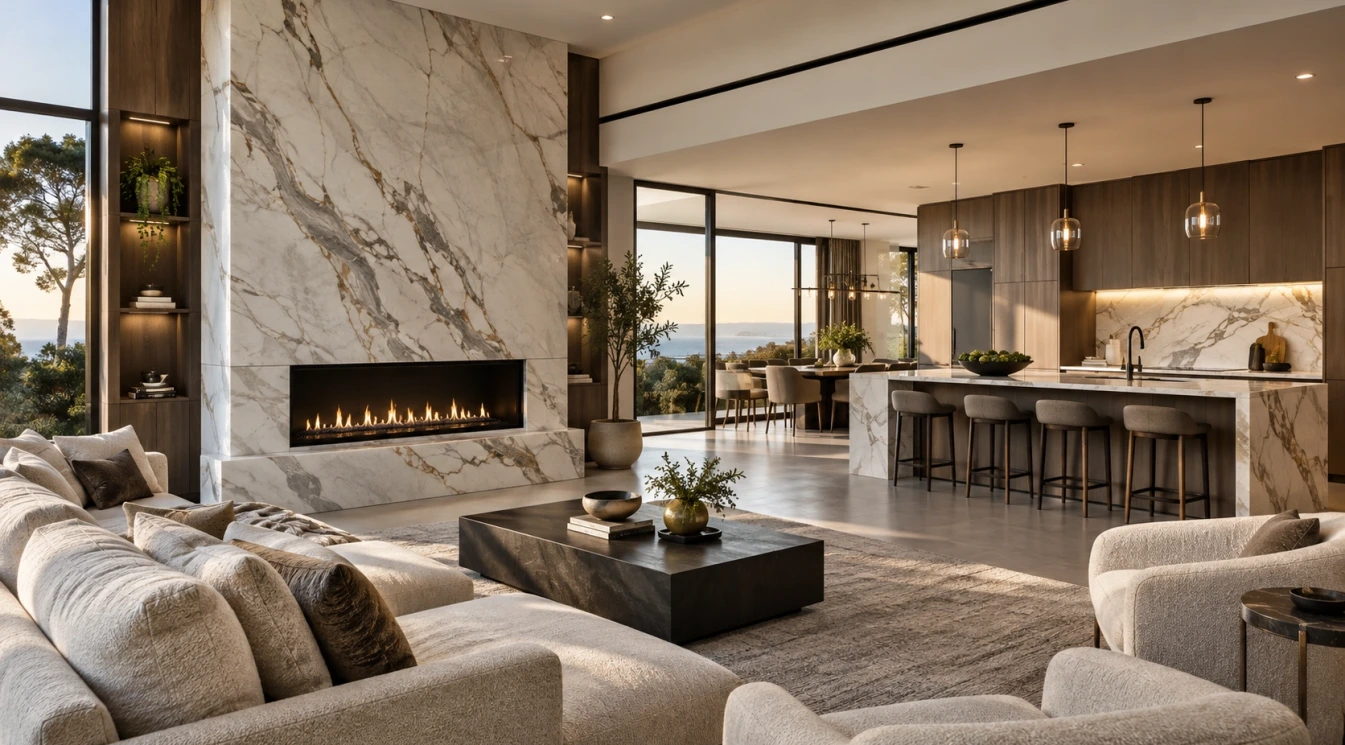
A porcelain slab is most impressive when it is allowed to read as one continuous plane. That is why it often works so well on walls, backsplashes, fireplace surrounds, shower panels, and other large feature areas. The eye sees the full surface first, then the pattern and finish. This is different from small tile, where the grout rhythm and individual pieces become part of the design.
For homeowners who like a clean modern style, porcelain slabs can reduce visual interruption. For homeowners who appreciate natural stone but want a different care profile or a more controlled surface, porcelain can offer marble-look, limestone-look, concrete-look, or dramatic stone-look patterns in a manufactured material. The result can feel refined without asking the room to carry too many competing details.
Why Showers Are One of the Strongest Uses
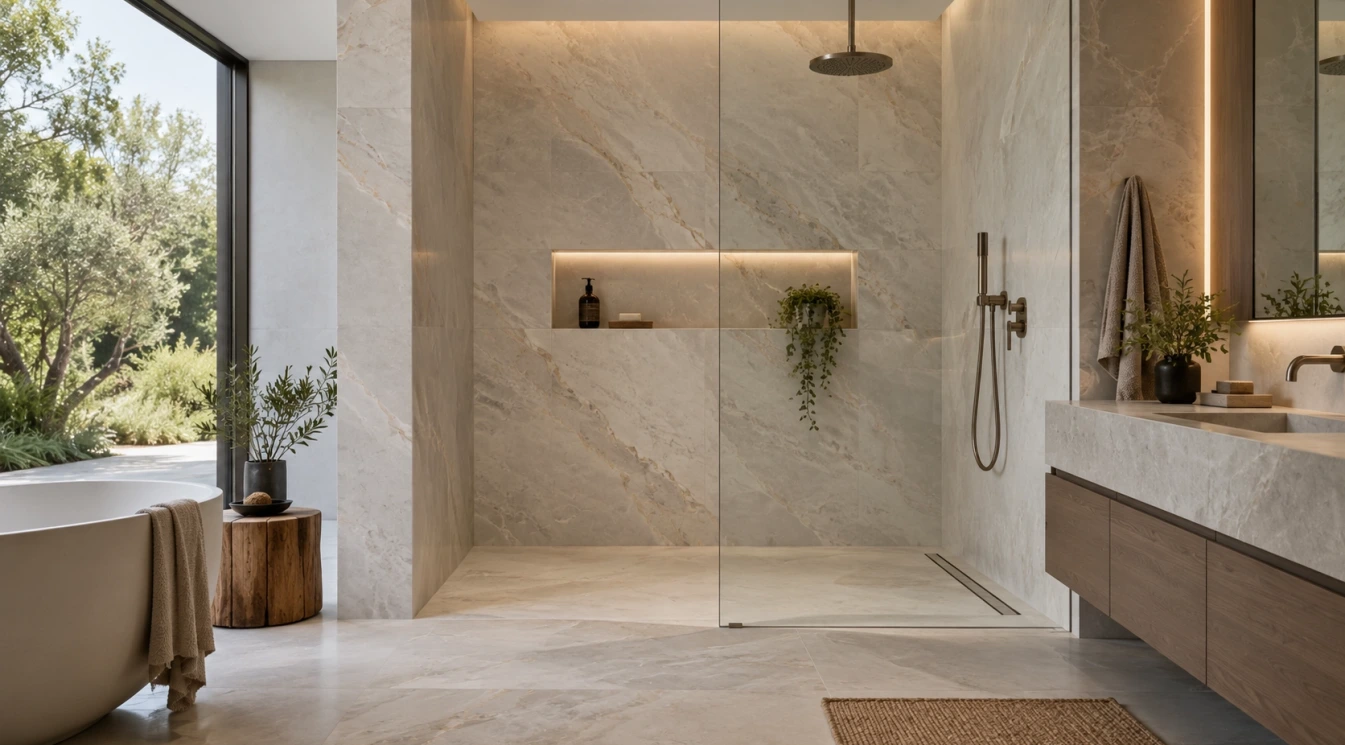
Showers are one of the most natural places to consider porcelain slabs. A shower wall built from large panels can feel calmer than one built from many smaller pieces. Fewer grout joints can also make the shower look visually cleaner, especially in a primary bathroom where the goal is a spa-like atmosphere.
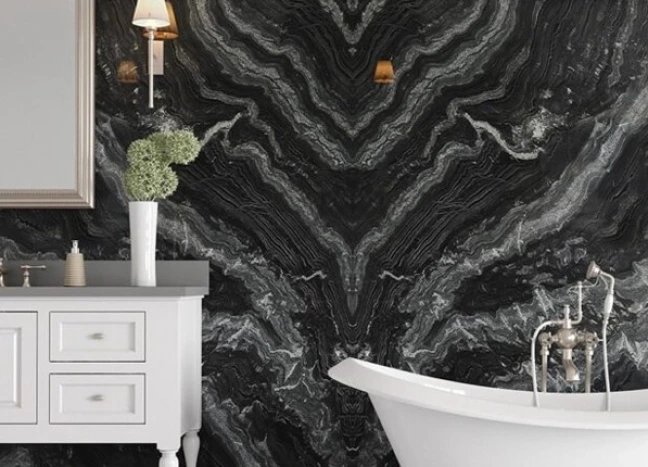
Porcelain slab shower walls can work in curbless showers, alcove showers, large walk-in showers, and bathrooms where the shower is visible from the vanity or tub. A soft stone-look porcelain can make the shower feel quiet and warm. A darker slab can make it feel dramatic and moody. A marble-look porcelain can give the bathroom movement without using actual marble on the shower wall.
Shower Design Still Depends on the Details
Large panels do not remove the need for careful planning. Niches, benches, valves, shower heads, corners, drains, and glass placement all affect the final result. A porcelain slab with strong veining may need to be laid out so the movement feels intentional rather than abruptly interrupted by a niche or plumbing wall.
The installer and fabricator matter as much as the material. Large porcelain panels require careful handling, accurate cuts, proper substrate preparation, and clean edge details. A beautiful slab can lose its effect if the corners are rough, the niche layout feels random, or the seams fall in awkward places. The best shower designs treat the slab layout as part of the room design, not as a last-minute installation step.
Fireplace Walls Can Become the Room’s Main Feature
A fireplace wall is another strong porcelain slab application because it is already a natural focal point. In many living rooms, the fireplace sits at the center of the seating area. Covering that wall with a large porcelain surface can give the room a more finished and intentional presence.
Porcelain slab fireplace surrounds can be subtle or dramatic. A soft limestone-look slab may create a calm backdrop for wood floors and neutral furnishings. A dark stone-look slab can make the fireplace feel more architectural. A marble-look slab can bring movement and elegance without filling the wall with grout lines.
The proportion of the fireplace wall matters. A tall wall may need a slab with enough movement to avoid looking empty. A smaller fireplace surround may need a quieter pattern so the surface does not overwhelm the room. The right porcelain is not simply the one with the best sample. It is the one whose scale fits the wall.
Porcelain Slabs in Kitchens
In kitchens, porcelain slabs are often considered for full-height backsplashes, range walls, waterfall island panels, and selected countertop applications. A full-height porcelain backsplash can make the wall behind the range feel clean and modern. It can also connect visually with porcelain tile flooring or nearby wall surfaces.
Porcelain can be especially effective when the kitchen needs a strong vertical feature. A large slab behind a hood, open shelves, or floating wood accents can create a more custom look than a standard tile backsplash. In simpler kitchens, a porcelain slab can provide the main movement while cabinets and counters stay quieter.
For countertops and islands, the details deserve more attention. Edges, thickness, mitered returns, sink cutouts, appliance cutouts, overhangs, and fabrication quality all affect whether the finished surface feels high-end. Porcelain can look sleek, but it should be selected and fabricated with the intended use in mind.
Full-Height Backsplashes: Clean, Dramatic, or Quiet
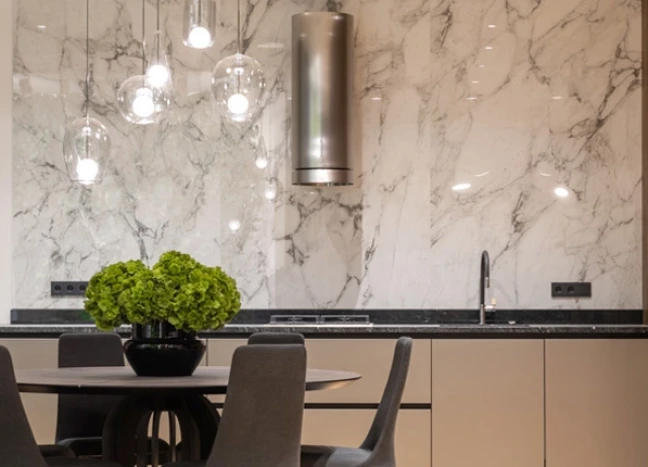
A full-height backsplash made from porcelain can work especially well when the kitchen already has simple cabinets and a restrained countertop. Instead of introducing a separate tile pattern, the slab creates one broad surface from the counter to the upper cabinets or hood area. This can make a small kitchen feel less broken up and a larger kitchen feel more architectural.
The backsplash does not have to be dramatic. Some of the strongest porcelain backsplashes are quiet: warm white, soft beige, pale gray, limestone-look, concrete-look, or subtle marble-look surfaces. That restraint lets the cabinets, hardware, lighting, and countertop breathe. A bold slab can also work, but it should be treated as the feature rather than just another background surface.
Porcelain slabs are most refined when they are planned as architectural surfaces, shaping the room with scale, calm, and continuity.
Porcelain vs Natural Stone for Feature Surfaces
Natural stone has depth, variation, and mineral character that cannot be fully duplicated. Granite, quartzite, marble, limestone, and travertine all have their own personality. For homeowners who love natural variation and do not mind caring for stone properly, natural stone remains a powerful choice.
Porcelain offers a different kind of control. It can provide consistent color, predictable patterning, large-format visuals, and surfaces that coordinate across showers, walls, backsplashes, and sometimes floors. It can imitate stone, but it should not be judged only by how closely it copies stone. Its value is often in giving the room a broad, calm surface with fewer visual interruptions.
Porcelain vs Tile: Not the Same Design Effect
Smaller tile and porcelain slabs can both be beautiful, but they create different rooms. Tile adds rhythm. The shape, grout line, pattern, layout, and scale become part of the design. That can be perfect for handmade-look backsplashes, shower floors, decorative bathroom walls, laundry rooms, and traditional kitchens.
Porcelain slabs reduce that rhythm. They make the surface feel calmer and more continuous. That can be ideal for modern bathrooms, large shower walls, fireplace features, and kitchen range walls. The choice is not simply which material is better. It is whether the room needs texture and pattern from tile or broad continuity from slab.
Do Not Forget Edges, Corners, and Transitions
Porcelain slab projects succeed or fail in the details. Outside corners, inside corners, exposed edges, miters, transitions to drywall, transitions to tile, shower niches, fireplace returns, and countertop edges all need to be planned. A slab surface looks most refined when the edges feel intentional and the transitions are not an afterthought.
That is especially important where porcelain meets other materials. A fireplace wall may meet painted drywall, wood flooring, cabinetry, or a hearth. A shower wall may meet glass, floor tile, a bench, a niche, or a ceiling line. A kitchen backsplash may meet countertops, cabinets, outlets, windows, and range hoods. These meeting points are where the design becomes real.
How to Choose the Right Porcelain Slab Look
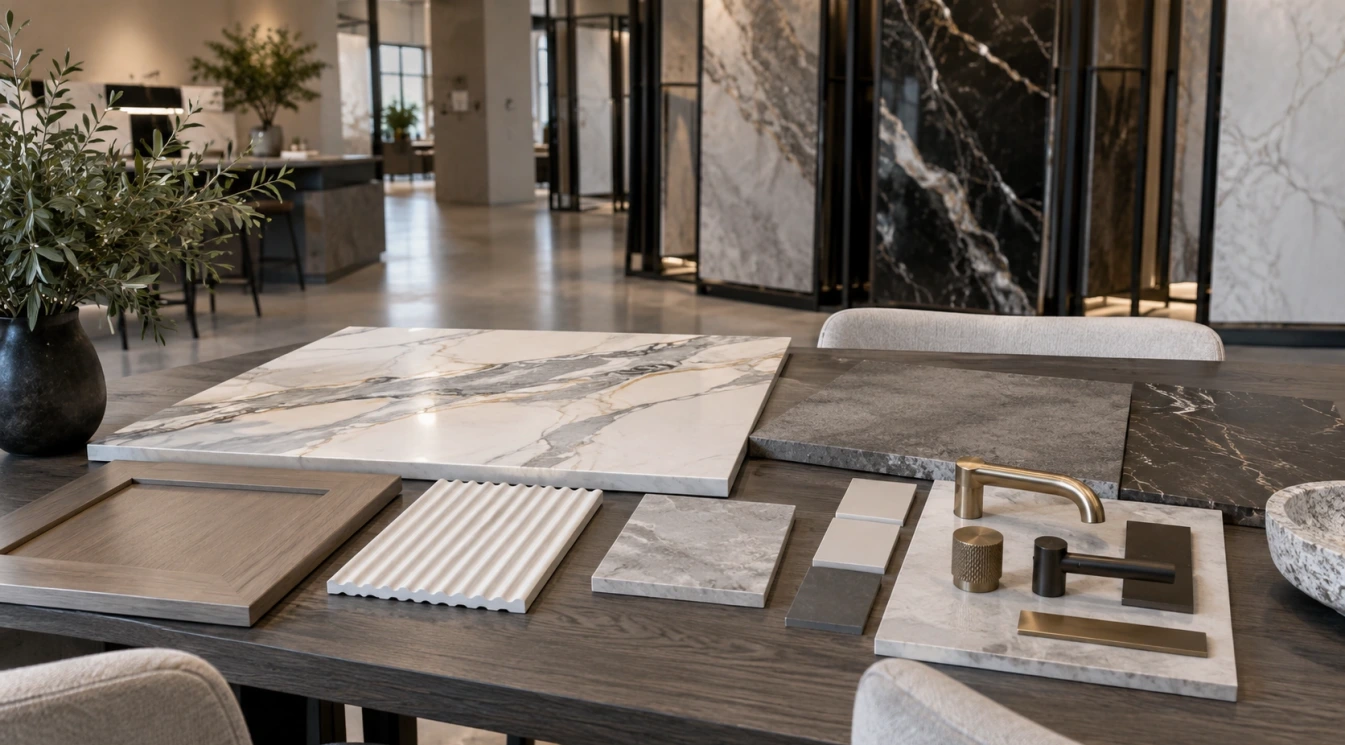
Start with the room’s role. A primary bathroom may benefit from a softer stone-look porcelain that creates calm. A powder room may be able to carry a more dramatic wall. A fireplace wall may need enough movement to anchor the living room. A kitchen range wall may need a surface that works with cabinet color, countertop tone, and hardware finish.
Then look at pattern scale. Large veining can be beautiful, but it may feel too strong in a small shower or behind a compact vanity. A subtle surface may look elegant across a large wall but too plain if the rest of the room is also quiet. Step back from the sample whenever possible. Porcelain slabs should be judged from the distance at which they will be seen after installation.
Where Porcelain Slabs May Not Be the Best Fit
Porcelain slabs are not always the right answer. A homeowner who wants the irregularity and depth of natural stone may prefer quartzite, marble, granite, or another stone surface. A traditional kitchen may feel warmer with ceramic tile or natural stone tile. A floor that needs smaller-format pieces for slope, grip, or layout may not be suitable for a large slab surface.
Cost, fabrication, access, handling, and installation complexity should also be part of the conversation. Large panels require planning. Tight stairways, small bathrooms, awkward corners, elevators, and narrow jobsite access can all affect what is practical. The best material choice is not only about appearance; it is about whether the design can be executed cleanly.
Compare Porcelain With the Whole Room in Mind
Porcelain slabs are most successful when they are compared with the surrounding materials before the final choice is made. Cabinet finishes, countertop samples, floor tile, wall paint, wood tones, faucet finishes, lighting, and glass all affect how the slab will appear. A cool white porcelain may feel crisp in one room and harsh in another. A warm stone-look panel may feel calm beside wood cabinets but too beige beside cooler finishes.
Domus Surfaces can help Sacramento homeowners compare porcelain slabs with tile, countertops, cabinets, flooring, and natural stone options so the final material choice fits the room instead of standing alone. Used in the right place, porcelain can give a shower, fireplace wall, or kitchen feature the kind of quiet impact that lasts beyond the first impression.